
Performance evaluation of IEEE 802.11g/n compliant wireless networks under different interference scenarios: Downlink
Article Sidebar
Main Article Content
Abstract
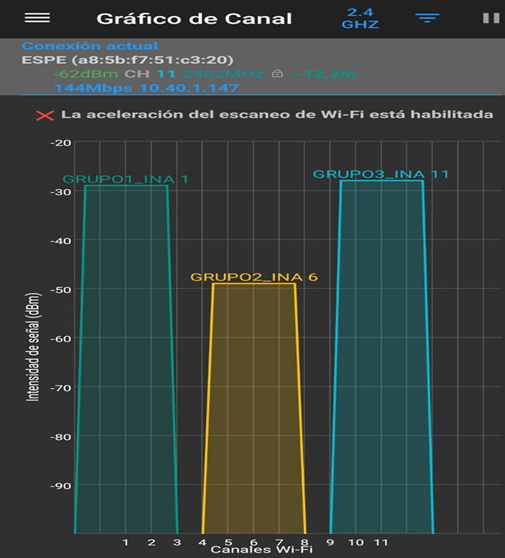
In this study, the performance of IEEE 802.11g and IEEE 802.11n wireless networks was investigated under different interference scenarios. Quality of service metrics include throughput, delay, delay variability, and packet loss rate. Experiments conducted in intra-apartment environments began with co-channel interference, with all devices connected on the same channel. Each device then broadcasts on a different channel, thereby minimizing interference. Intrusive traffic in the protocol was used for precise metrics measurements. Results indicate that performance varies depending on the standard and channel configuration. Overall, IEEE 802.11n offers superior performance, although it is more susceptible to interference compared to IEEE 802.11g. Transmission efficiency suffers significantly in the presence of co-channel interference, with throughput losses reaching up to 35% in specific scenarios. This study underscores the importance of proper channel planning to maximize throughput and mitigate the adverse effects of interference.
Downloads
Article Details
Section

This work is licensed under a Creative Commons Attribution 4.0 International License.
Authors who publish in this journal agree to the following terms: Authors retain the copyright and guarantee the journal the right to be the first publication of the work, as well as, licensed under a Creative Commons Attribution License that allows others share the work with an acknowledgment of the authorship of the work and the initial publication in this journal. Authors may separately establish additional agreements for the non-exclusive distribution of the version of the work published in the journal (for example, placing it in an institutional repository or publishing it in a book), with acknowledgment of its initial publication in this journal. Authors are allowed and encouraged to disseminate their work electronically (for example, in institutional repositories or on their own website) before and during the submission process, as it may lead to productive exchanges as well as further citation earliest and oldest of published works.
How to Cite
References
[1] Norma IEEE para Tecnología de la Información—Redes de área local y metropolitana—Requisitos específicos—Parte 11: Especificaciones de control de acceso al medio (MAC) y capa física (PHY) de LAN inalámbrica, Enmienda 5: Mejoras para un mayor rendimiento.
[2] D. Crespo Sen, "Mecanismos de asignación de canales en redes IEEE 802.11", Universidad de Alcalá, 2019. [En línea]. Disponible: https://ebuah.uah.es/dspace/bitstream/handle/10017/38651/TFG_Crespo_Sen_2019.pdf
[3] C. Muñoz Morales, "Análisis de Desempeño de un Sistema MIMO-OFDM con Predicción de Canales", Tesis Doctoral, Universidad Nacional de Colombia, Bogotá DC., 2013.
[4] S. H. Masood, "Comparación del rendimiento de IEEE 802.11g e IEEE 802.11n en presencia de interferencia de red 802.15.4", preimpresión de arXiv arXiv:1308.0678, 2013. [En línea]. Disponible: https://arxiv.org/abs/1308.0678.
[5] R. A. Lara Cueva, C. B. Fernández Jiménez y C. A. Morales Maldonado, "Análisis de rendimiento en un enlace descendente de redes basadas en los estándares IEEE 802.11b, IEEE 802.11n y WDS", Reci, vol. 5, núm. 10, 2016.
[6] S. H. Masood, "Comparación del rendimiento de IEEE 802.11g e IEEE 802.11n en presencia de interferencia de red 802.15.4", preimpresión de arXiv arXiv:1308.0678, 2013. [En línea]. Disponible: https://arxiv.org/abs/1308.0678
[7] S. M. Kala, M. P. K. Reddy, R. Musham, B. R. Tamma, "Asignaciones de canales conscientes de la coubicación de radio para la mitigación de interferencias en redes de malla inalámbricas", preimpresión de arXiv arXiv:1503.04533, 2015. [En línea]. Disponible: https://arxiv.org/abs/1503.04533
[8] J. L. Muñoz, "Análisis de Desempeño en Redes WLAN: Estudio de Caso", Universidad Católica de Colombia, 2014. [En línea]. Disponible: https://repository.ucatolica.edu.co/bitstream/10983/1300/3/Articulo_trabajo%20de%20grado.pdf
[9] R. A. Lara Cueva, C. B. Fernández Jiménez, C. A. Morales Maldonado, "Análisis de rendimiento en un enlace descendente de redes basado en los estándares IEEE 802.11b, IEEE 802.11n y WDS", Reci, vol. 5, núm. 10, 2016. [En línea]. Disponible: https://www.reci.org.mx/index.php/reci/article/view/92/404
[10] L. F. Pedraza, "Consideraciones para la implementación de la voz sobre WLAN", Universidad Industrial de Santander, 2006. [En línea]. Disponible: https://noesis.uis.edu.co/bitstreams/33e56af9-f5b4-44d7-8572-ffc4339b29b8/download